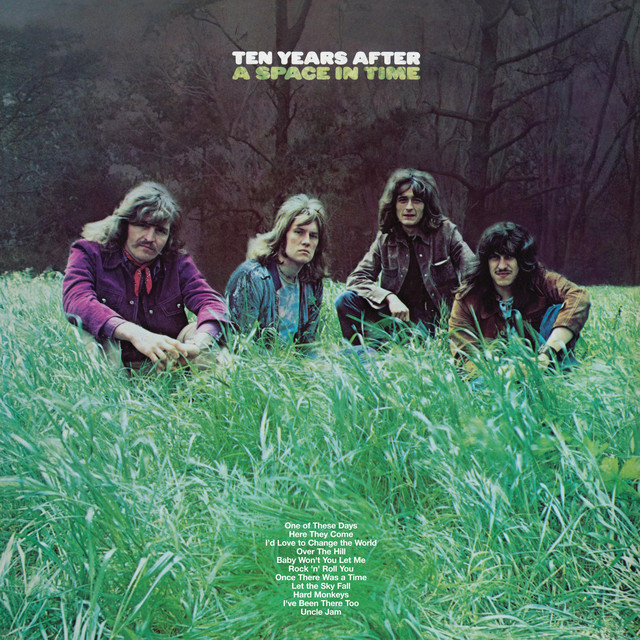
I'd Love to Change the World
Alvin Lee was the fastest guitarist at Woodstock. The song that outlived everything is the one where he admits speed couldn't help.
Alvin Lee was the fastest guitarist at Woodstock.
Not as a compliment. As a fact. His performance of “I’m Going Home” made his name because nobody watching could believe a human being could play that fast. That was the thing he did better than anyone on that stage. And the song that outlived everything else Ten Years After ever recorded is the one where he admits the one thing speed couldn’t touch.
“I’d love to change the world, but I don’t know what to do.”
That’s the whole confession. Not bravado. Not a plan. Not a call to anything. A man saying out loud that wanting to fix things is not the same as knowing how.
By 1971, Lee was watching the sixties dream curdle into something uglier. The song opens by listing what’s wrong — war, taxes, pollution, hatred — and for a verse it sounds like a protest anthem, the kind that ends with marching orders. Then the chorus arrives and there are no orders. He isn’t rallying anybody. He’s sitting down, exhausted, admitting he’s out of ideas.
You can hear it in the arrangement before you hear it in the words.
The verses are acoustic — delicate, almost pretty, the sound of a man laying the problem out calmly. Then the chorus hits and the heavy electric riff takes over, and what takes over with it is frustration. Good intentions collapsing under their own weight. The guy who rocked Woodstock finding out, in real time, that rock and roll wasn’t going to change anything.
There’s one line that gets quoted as a slogan, and it isn’t one. “Tax the rich, feed the poor, till there are no rich no more.” Simple math. Obvious solution. Fifty years later, we’re still waiting. Lee knew that’s how it would go. That’s why the line sits inside a song about not knowing what to do, instead of a song that claims to.
What makes this song last isn’t the politics. The politics were everywhere in 1971, and most of the songs that carried them are gone.
What lasts is the vulnerability. Lee had every easier option. He could have written a finger-pointing anthem — blamed the government, blamed the man, blamed somebody, anybody, else. Finger-pointing songs are cheap to write and they feel good to sing. He did the harder thing and put himself in the failure. We all want to change the world. None of us know what to do. He didn’t exempt the man holding the guitar.
That honesty hits harder than any slogan, because a slogan asks nothing of the person saying it. This asks everything. Some protest songs tell you what to think. This one admits that thinking isn’t enough. That’s a strange thing for a hit song to say, and a stranger thing to be remembered for, and it’s the truest line anybody in that scene wrote about what it felt like when the decade ended and the problems were all still there.
The politics that surrounded it in 1971 are mostly gone, and so are most of the songs that carried them. This one stayed. It outlived everything else Ten Years After recorded, and it is the track Alvin Lee is remembered for now — not the speed that made his name at Woodstock, but the three minutes and fifty seconds in which he admitted he didn’t know what to do.