My My, Hey Hey
Neil Young wrote a line in 1979. Fifteen years later Kurt Cobain quoted it in his suicide note.
The story everyone carries around goes like this: Neil Young declared that it’s better to burn out than to fade away, and fifteen years later Kurt Cobain quoted the line in his suicide note, taking him at his word.
Half of that is true. Cobain did quote it, and the line never came off the song afterward — it stopped being a lyric and became something heavier, an epitaph, a curse, an accusation, a question with no clean answer. But the other half, the part where the line was ever a manifesto, is the wrong story.
Start with what’s actually around it. Young sings rock and roll will never die right after the burning-out line, and people skip past it every time. The song isn’t choosing between burning out and fading away. It’s saying neither one is the point — the music outlasts both. That’s the consolation and the terror of it.
And the line wasn’t written about anyone’s death. It was written, in part, about Johnny Rotten. Johnny Rotten’s sitting there, he’s waiting on the news sat in the earliest drafts, later compressed to the King is gone but he’s not forgotten. The question underneath was the plain one about surviving rock and roll: how do you keep making the thing without it becoming costume? How do you stay dangerous when danger is what they paid to see? The punks had one answer — burn it down and walk away. Young had another: keep moving, keep rusting, keep making the thing even when it embarrasses you. The lyric is a negotiation between those two answers, not a verdict for either.
The album came out in 1979. Cobain was twelve years old. The connection wasn’t intended and couldn’t have been, and Young has said he’s had to live with it anyway — has called it the worst thing he ever wrote. He has also said he still plays the song. Both are true at the same time, which is about right for a line that was never as simple as it sounded.
Even the title refuses to mean one thing. My my, hey hey came out of a conversation with Jeff Blackburn, a musician from the Bay Area who’d been kicking the phrase around for years — four syllables, pure rhythm, nothing semantic. Young built the song around them and gave Blackburn a co-writing credit. The phrase sounds like a sigh and a shout at the same time.
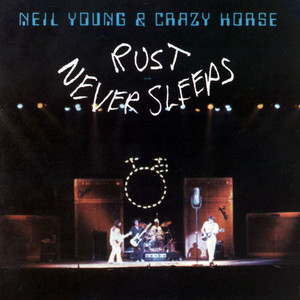
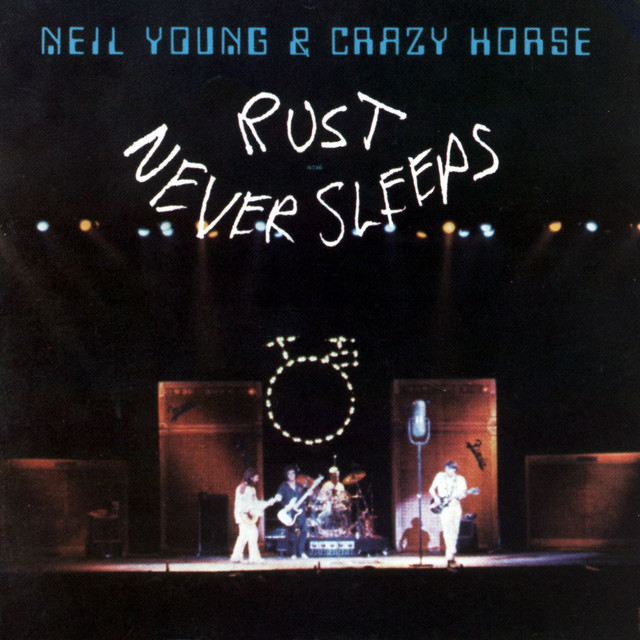
There are two recordings, sent in opposite directions. The electric version with Crazy Horse is a dirge that moves — Frank Sampedro’s guitar hanging in the mix like smoke, Billy Talbot and Ralph Molina locked into a groove that never quite resolves, Young soloing like he’s searching for the end of the song and can’t find it. When he finally gets there, it stops. No fade. Just done.
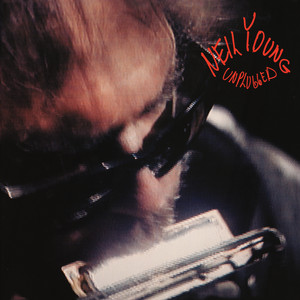
The acoustic version is the one I keep coming back to. San Francisco, 1978, Young playing alone, his guitar slightly out of tune in the way that only sounds right on certain songs. It’s a song about mortality and irrelevance and the strange act of making music in the face of both, and near the end — a recording accident — you can hear him breathing. Still there, still doing it.