Funeral for a Friend/Love Lies Bleeding
The funeral march breaks at the five-minute mark and the piano comes crashing in. Eleven minutes, no skipping ahead.
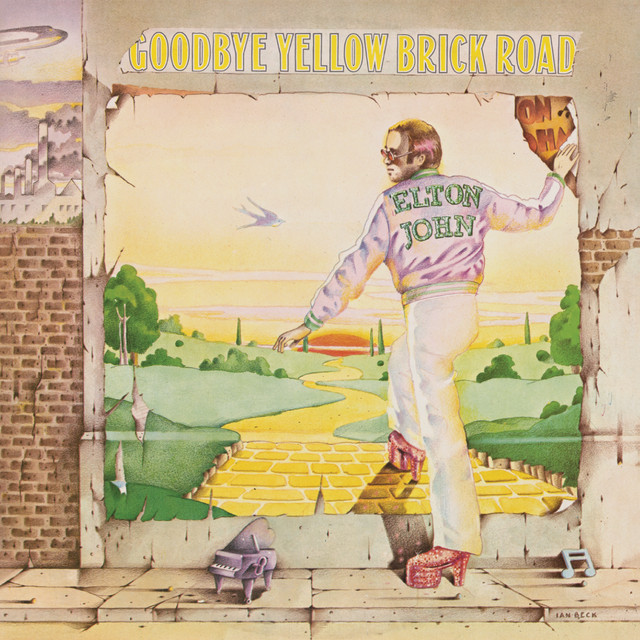
In 1973, Elton John and Bernie Taupin opened Goodbye Yellow Brick Road with eleven minutes of music, and for the first five of them nobody sings. “Funeral for a Friend” is an instrumental — synthesizers, a funeral march, no words at all. Then, around the five-minute mark, the march breaks, the piano chords come crashing in, and you are in “Love Lies Bleeding.” That transition is the fact I keep coming back to. Everything I want to say about this song lives inside it.
It is eleven minutes that ask for all eleven. You don’t put this on as background. You put it on and it takes the room, and for as long as it runs nothing else gets in. That is unusual for a piece of music. It is almost unheard of for the opening cut on a pop record.
Start with the first half, because the first half earns the second. “Funeral for a Friend” is indulgent. It is excessive. It is prog-rock at full pomp, synthesizers swirling, and it works anyway — not despite the excess but because of it. You cannot have the release at minute five without the weight of the four minutes before it. The march has to go on long enough that you stop waiting for it to end.
Then it ends. And what comes next is not gentle. Elton is pounding those keys, and the band is tight, absolutely locked in. After five minutes of mourning, “Love Lies Bleeding” does not ease you back into the world. It throws the doors open.
Look at what the title actually is: two names joined by a slash. A funeral on one side, something still bleeding — still alive — on the other. The slash is the five-minute mark. Most songs pick one of those two things to be about. This one builds the first so that the second means something, and the join between them is the most honest thing on the record. Grief does not fade out. At some point it just breaks, and you find yourself moving again before you’ve decided to.
I don’t think you can write that. I think you can only build it, the way they built it — minute by minute, so the listener has to live through the long part to get to the loud part.
It is the kind of track that makes you believe, briefly and wrongly, that you could play piano — Elton’s part is so propulsive it pulls your hands toward an imaginary keyboard. Then, around the six-minute mark, Davey Johnstone’s guitar comes snarling in, and you’re caught switching between air-piano and air-guitar like nobody is watching. It demands full participation.
I mean that last sentence plainly. This is not a song that plays in the background. It does not let you stay outside it.
It is a song people come back to at the hinge moments — the breakups, the actual funerals, the long drives where the only company is the yellow lines and your own thoughts. The march plays, the march breaks, and whatever you carried into those eleven minutes tends to weigh a little less on the way out.
Goodbye Yellow Brick Road gave us “Bennie and the Jets,” “Candle in the Wind,” all the hits. They earned their place. But the album opens with this, and I believe the placement was the statement. The hits are the celebration. This is the reckoning, and they put the reckoning first.
Eleven minutes. No skipping ahead. No half-measures. You commit to the whole thing or you don’t bother at all. That is the deal Elton and Bernie made with the listener fifty years ago, and it has not expired.
The march plays. The march breaks. It has been breaking the same way, at the five-minute mark, for fifty years — and it will break that way for anyone who gives it the eleven minutes it asks for.